8 Differentiated Instruction Strategies for Teachers—Proven
You’ve got 25+ students in your classroom, and they’re all over the map, different reading levels, different learning speeds, different interests, different backgrounds. One lesson plan isn’t going to cut it. That’s exactly why differentiated instruction strategies for teachers matter so much. They give you a framework for reaching every student without burning yourself out in the process.
But here’s the thing: most resources on this topic either stay too theoretical or dump a laundry list of ideas with zero classroom context. At The Cautiously Optimistic Teacher, we build tools and resources specifically to help educators adapt their instruction to diverse learners, from our AI-powered Differentiated Instruction Helper to our ready-to-use unit plans. This article comes from that same place: practical, proven, and teacher-tested.
Below, you’ll find eight differentiated instruction strategies that actually work in real classrooms. Each one includes concrete examples and tips so you can start using them this week, not someday after a three-hour PD session. Whether you’re differentiating by content, process, product, or environment, these strategies will help you meet students where they are, and move them forward.
1. Use an AI Differentiated Instruction Helper
AI tools built specifically for teachers can cut your planning time significantly. The Cautiously Optimistic Teacher’s Differentiated Instruction Helper is one of the most practical differentiated instruction strategies for teachers available right now. It generates tiered content, modified instructions, and scaffolded tasks based on your input, so you spend less time rewriting lessons and more time actually teaching.
What it does and what it does not do
The AI helper generates differentiated versions of your existing content: modified texts, tiered tasks, simplified instructions, and extension prompts. What it does not do is make pedagogical decisions for you. You still choose the learning objective, decide which students need what, and review every output before it reaches a student.
Think of the AI as a fast planning assistant, not a replacement for your professional judgment.
What to feed it so it gives useful outputs
The quality of the output depends directly on the specificity of your input. Give it the grade level, the standard you are targeting, a clear description of the student’s needs (for example, reading two levels below grade, ELL, or working above grade level), and the original task or passage. Vague prompts produce generic results that will take you longer to edit than if you had written the content yourself, so the more context you provide, the more usable the output.
Ways to use it for content, process, and product
You can use the tool across all three dimensions of differentiation. For content, generate a simplified or enriched version of a reading passage. For process, create step-by-step instructions for students who need structure alongside open-ended prompts for independent workers. For product, produce varied task options that target the same standard but let students demonstrate understanding in different ways.
How to keep differentiation fair, consistent, and manageable
Run the same prompt structure every time you use the tool so your differentiation stays consistent across units. Keep a simple log, even a notes column in your gradebook, of which students received which version of a task. Tracking this helps you notice patterns in student needs over time and prevents you from defaulting to the same modifications for the same students without checking whether they still need that level of support.
2. Start with a Quick Pre-Assessment and Flexible Groups
Pre-assessment is one of the most practical differentiated instruction strategies for teachers because it removes guesswork. Instead of planning around assumptions, you find out exactly where each student stands before you design instruction, which means every grouping decision you make has a clear, data-backed reason behind it.
Fast Ways to Check Readiness in Under 10 Minutes
You do not need a formal quiz to get useful information. A 3-question exit ticket, a quick thumbs-up/thumbs-down vocabulary check, or a one-sentence written response to a prompt can reveal who is ready, who needs review, and who already has the concept locked down. Digital polling tools built into platforms many schools already use, like Google Forms or Microsoft Forms, let you collect and sort responses in minutes.
The goal is not a grade, it is a snapshot you can act on immediately.
How to Form Groups That Stay Flexible and Stigma-Free
Label groups by topic or task name, never by ability level. Students are perceptive, and ability-based labels create self-fulfilling expectations. Rotate the membership regularly so students understand that group placement reflects the current task, not a permanent judgment about their intelligence.
What to Do While You Meet with a Group
The rest of the class needs a clear, self-managed task before you pull a small group. Assign independent practice, reading responses, or review work that students can complete without interrupting you.
How to Regroup Without Derailing the Lesson
Keep your regrouping tied to new data, not just the calendar. When a student’s exit ticket shows mastery, move them. A simple sticky-note system on your desk lets you update group assignments quickly between lessons without rewriting anything.
3. Offer Choice Boards for Practice and Projects
Choice boards give students a structured set of options for demonstrating mastery while keeping every task tied to the same learning objective. As one of the most flexible differentiated instruction strategies for teachers, a well-designed choice board reduces your planning burden while increasing student ownership of the work.
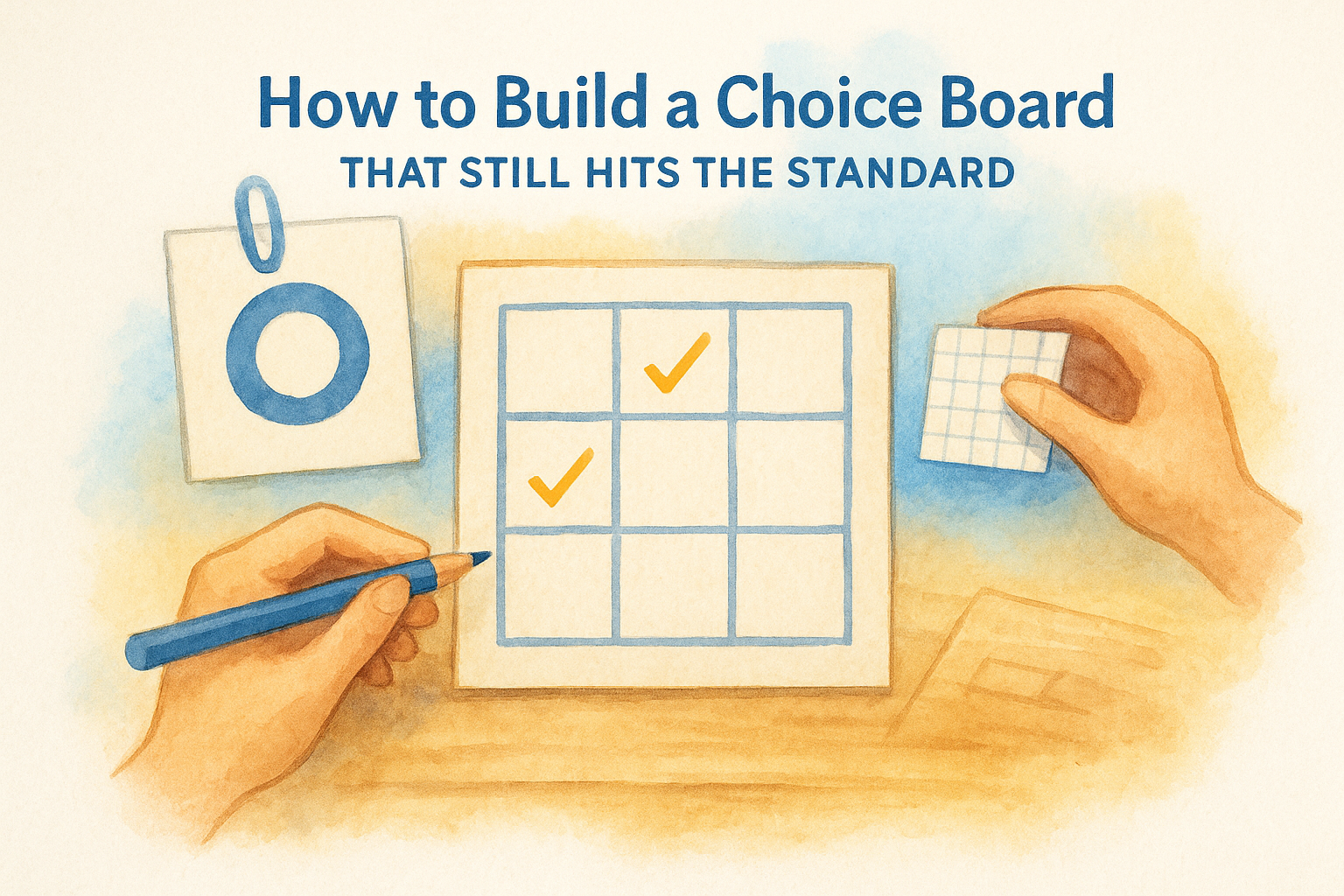
How to Build a Choice Board That Still Hits the Standard
Build your board by starting with the standard or learning target first, then designing tasks that require students to apply the same skill in different ways. A 3×3 grid works well, with tasks ranging from recall to application to creation. Every cell should require the same core knowledge, just expressed through a different format.
How to Set Guardrails So Choices Stay Rigorous
Not all student choices lead to deep learning. Set clear minimum requirements for each task, such as a word count, a required number of examples, or a specific source type, so students cannot drift toward a low-effort product. This keeps your differentiation rigorous rather than just varied.
Every option on your choice board should demand the same cognitive load, even if the format looks different.
Examples for ELA, Math, Science, and Social Studies
Subject-specific tasks make choice boards concrete. In ELA, options might include a character analysis, a written dialogue, or a recorded reading response. In math, students could solve a real-world problem, explain a concept in writing, or build a visual model. Science and social studies boards work well with debates, labeled diagrams, and short reports.
How to Grade Choice Without Creating Eight Rubrics
Use a single-standard rubric focused on the learning target rather than the task format. Since every choice addresses the same objective, one rubric covers all options cleanly without adding grading time.
4. Create Tiered Assignments for the Same Objective
Tiered assignments are one of the most effective differentiated instruction strategies for teachers because every student works toward the same learning objective while receiving appropriately challenging tasks. You keep the standard consistent; only the level of support and complexity changes.
How to Tier by Support and Complexity Without Tracking Kids
Design each tier around the same core skill, but adjust the scaffolding and cognitive demand. Distribute tasks without drawing attention to who gets what, and use neutral names like Task A, B, and C rather than labels that signal rank.
The goal is to match the challenge to the student, not to sort students into permanent categories.
Students rarely notice tier differences when all options look purposeful. Frame each version as a different angle on the same problem, not a different problem entirely.
How to Write Three Tiers Quickly from One Core Task
Start with your on-grade-level task, then work outward in both directions:
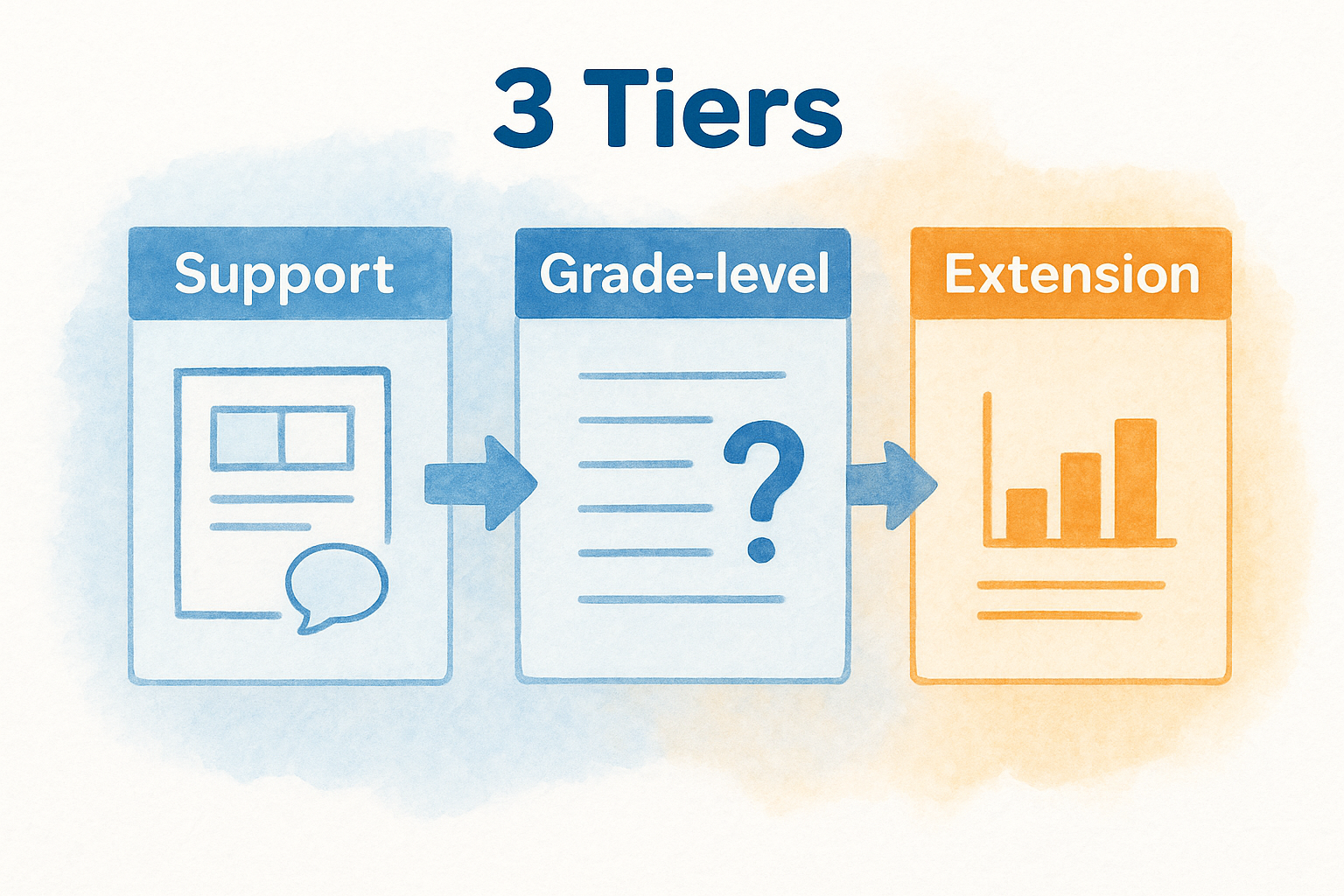
- Support tier: add sentence frames, graphic organizers, or a shortened version of the source text
- Grade-level tier: the standard task with clear instructions and a focus question
- Extension tier: remove scaffolds and raise complexity by asking students to evaluate, compare, or apply
Examples You Can Reuse Across Units
A text-based analysis task becomes three tiers cleanly across subjects:
- ELA/Social Studies: guided annotation, focused analysis, open-ended comparative essay
- Science/History: labeled diagram with prompts, short explanation, independent evaluation of evidence
How to Decide When a Student Moves Tiers
Use exit tickets and short formative checks to trigger tier changes rather than the unit calendar. When a student’s work consistently meets the objective, move them up.
Build brief checkpoints into each week so students do not stay in a tier they have already outgrown. Moving students up promptly keeps the challenge appropriate and prevents boredom from setting in.
5. Teach with Small-Group Workshops During Independent Work
Small-group workshops are one of the most powerful differentiated instruction strategies for teachers because they let you deliver targeted instruction to a few students at a time while the rest of the class works independently. You get focused, low-distraction teaching time without splitting your class into separate lessons.
How to Structure a Simple Workshop Block
Set aside 15 to 20 minutes inside your existing independent work period. Pull three to five students to a small table while everyone else completes a task they can manage without your help. Keep the workshop tight and purposeful: one clear skill, one shared objective, done.
A workshop block does not require a new lesson plan, it just requires a clear purpose and a class that knows the routine.
How to Keep the Rest of the Class Productively Busy
Assign independent practice tied directly to the current unit so students are not waiting for your direction. Anchor activities, such as reading responses, vocabulary review, or math practice sets, keep students on-task without needing you to manage them every few minutes.
What to Teach in Each Group and How Long to Stay
Use your pre-assessment data to decide what each group needs: reteaching, guided practice, or extension. Spend no more than 15 minutes per group to stay efficient and rotate across the week.
How to Capture Notes So You Remember What Each Student Needs
Keep a simple one-page tracking sheet with student names and a column for quick observations. Jotting down two or three words per student during or right after the workshop prevents you from losing useful data before your next planning block.
6. Scaffold on Purpose, Then Remove Supports
Scaffolding is one of the most misunderstood differentiated instruction strategies for teachers. Done well, scaffolds give students just enough support to access the task and then step back as students build independence. Done poorly, they become permanent crutches that prevent students from ever working without help.
What Scaffolds Actually Help and Which Ones Become Crutches
Helpful scaffolds reduce barriers without replacing thinking: sentence starters that prompt structure, graphic organizers that chunk a complex task, and anchor charts that students reference rather than copy. Crutches, on the other hand, do the cognitive work for students, such as providing answer banks for every assessment or rewriting texts so heavily that the original rigor disappears entirely.
High-Leverage Scaffolds You Can Add in Minutes
Three scaffolds deliver strong results with minimal prep: a structured note-taking template, a vocabulary reference card, and a worked example students can study before attempting their own. Each one keeps the intellectual demand on the student while lowering the barrier to entry.
Build scaffolds into your standard lesson files so you always have a modified version ready without starting from scratch.
How to Fade Scaffolds So Students Own the Work
Remove one support at a time rather than pulling everything at once. Start by removing the most directive element, such as sentence frames, and see whether performance holds. If it does, remove the next layer at the following checkpoint.
How to Support IEP, 504, and Multilingual Learners Without Isolating Them
Distribute scaffolds broadly across the class so no single student feels singled out. When you offer graphic organizers or visual supports to everyone, students who need them most use them without stigma, while students who do not need them simply set them aside.
7. Adjust Pacing with Flexible Timing and Checkpoints
Pacing is one of the most overlooked differentiated instruction strategies for teachers. Students do not all process information at the same speed, and designing your unit around a single timeline means some students rush while others stall. Flexible pacing keeps every student moving forward without turning your classroom into chaos.
How to Set the Same Deadline with Different Pathways
Keep one final deadline for the whole class but build multiple pathways to reach it. Some students need more practice steps along the way, while others move straight to application. Mapping out two or three routes to the same endpoint gives you structure while respecting different processing speeds.
How to Use Checkpoints to Prevent Last-Minute Pileups
Break larger assignments into two or three required checkpoints spread across the unit. Students submit drafts, outlines, or progress notes at each stop so you catch problems early. Interim check-ins spread across the unit prevent the scramble that happens when everyone turns in incomplete work on the final day.
Checkpoints shift your feedback earlier in the process, where it does the most good.
How to Plan Extension Work That Stays Aligned
Extension tasks should deepen the same standard, not just pile on more of the same work. Assign a related article, a comparison task, or a creative application that keeps faster students engaged with the objective rather than drifting into busywork.
How to Handle Unfinished Work Without Punishing Slower Processing
Give students who need more time a clear completion plan rather than a zero. A short written agreement with a new checkpoint date keeps accountability in place while acknowledging that processing speed is not a measure of ability.
8. Differentiate the Learning Environment with Routines
The physical and social setup of your classroom is one of the most underused differentiated instruction strategies for teachers. When students know exactly where to go and what to do, your environment becomes a support system rather than a source of confusion.
How to Design Routines That Support Independence
Strong routines reduce the number of decisions students need to make mid-task. Teach entry routines, transition signals, and task expectations explicitly at the start of the year, then reinforce them consistently so students move through your classroom without waiting for your direction at every step. Predictable structures free up cognitive space for actual learning.
When routines are automatic, students spend more energy learning and less energy figuring out logistics.
How to Set Up Quiet, Collaboration, and Teacher-Help Zones
Divide your room into clear zones with distinct purposes: a quiet independent work area, a space for partner tasks, and a spot near your instruction table where students can get support. Visual labels help students self-direct without interrupting you or their peers.
How to Use Directions That Students Can Access in Multiple Ways
Post written and visual instructions in a consistent spot so students who miss a verbal direction can find what they need independently. Recorded short audio prompts or video walkthroughs work well for students who process information better through listening.
How to Troubleshoot Common Management Issues
When students drift off-task or crowd your small-group table, the fix is almost always clearer expectations, not stricter consequences. Review the routine publicly, model the behavior again, and check whether your anchor tasks are engaging enough to hold student attention independently.
Next Steps
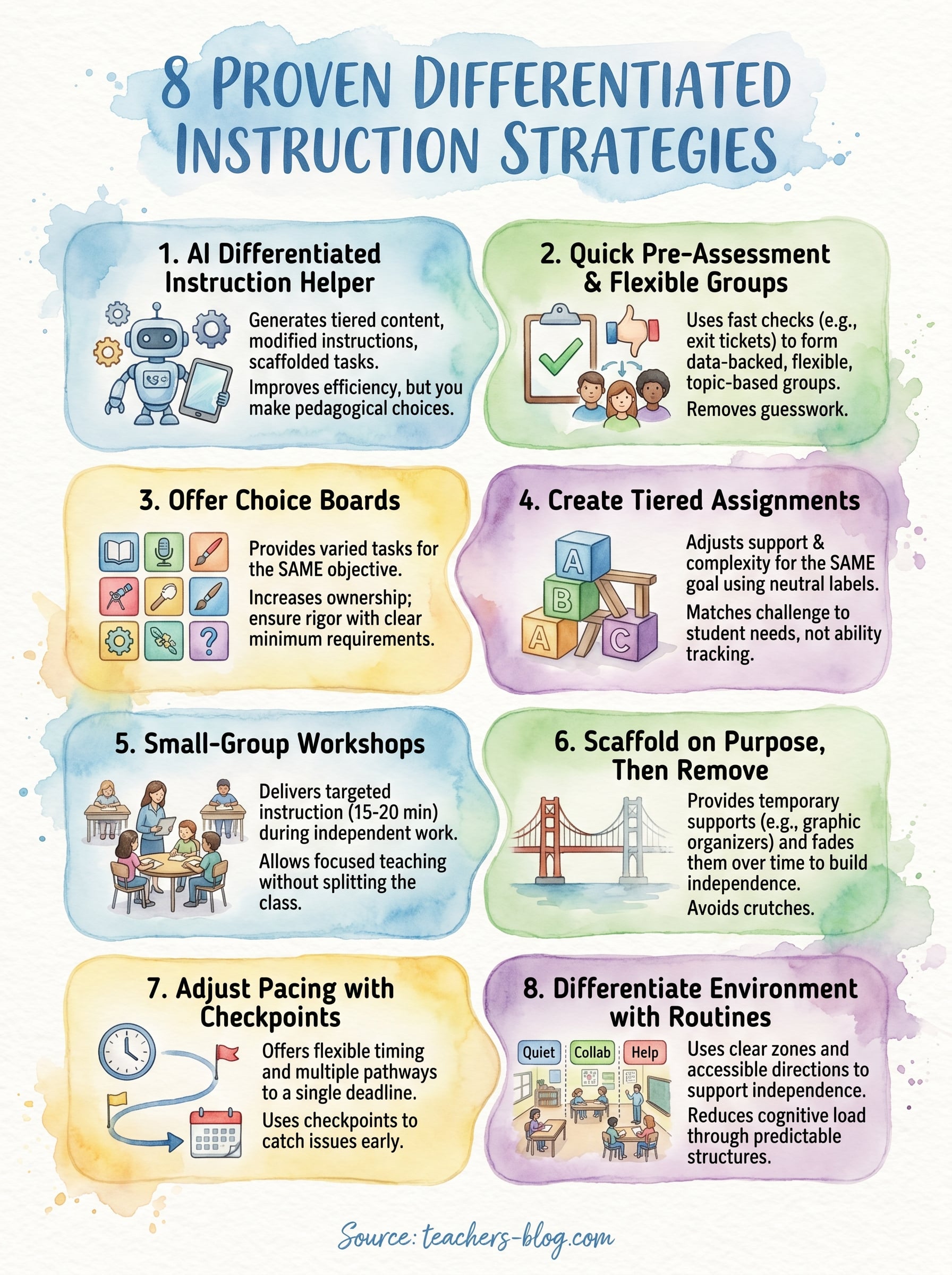
These eight differentiated instruction strategies for teachers give you a concrete starting point, not a theoretical framework you have to decode before Monday morning. Each strategy works on its own, but the real impact comes when you layer them together. Start with one, get comfortable, then add the next.
Your students benefit most when your differentiation is consistent and sustainable. Trying to implement everything at once leads to burnout, not better outcomes. Pick the strategy that fits your current unit, build the routine around it, and track what changes in student output and engagement over the following two weeks.
Ready to cut your planning time significantly? The Differentiated Instruction Helper at The Cautiously Optimistic Teacher generates tiered tasks, scaffolded instructions, and modified content based on your specific students and standards. Check out the full suite of teacher tools and find what fits your classroom today.